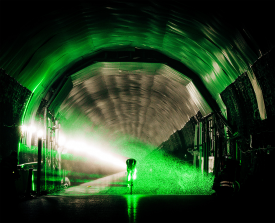
Ring-of-Fire - Real-world aerodynamic measurement for high-fidelity 3D flow capture
The Ring-of-Fire (RoF) is an advanced aerodynamic measurement concept designed to capture high-resolution flow data around moving objects under real-world conditions. It enables researchers and engineers to observe complete wake structures and transient aerodynamic effects that are difficult to reproduce in conventional stationary wind tunnel setups.
Developed by the Aerodynamics Group at TU Delft, the Ring-of-Fire concept is commercially supported and distributed by LaVision, providing a powerful tool for experimental fluid dynamics and CFD validation.
Concept Overview
In RoF, the test subject passes through the stationary measurement section. Within this section a wide sheet of light defines the actual measurement volume, in which thousands of tiny Helium-filled soap bubbles (HFSB) are tracing the movement of the flow. The measurement zone is further equipped with high-speed cameras capturing the bubble's scattered light. All the devices are synchronized and controlled via LaVision’s DaVis software. As the object of interest, such as a car, ball, or animal model, moves through the measurement section, the system captures a complete aerodynamic “snapshot” of the surrounding flow field.
- Real-world measurement conditions
- High fidelity full-wake data
- High spatial and temporal resolution
- Short acquisition times (approx. 1 sec/run)
- High industrial relevance
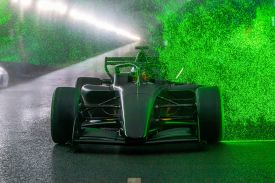
Automotive Aerodynamics
The Ring-of-Fire (RoF) system provides detailed insight into the complex wake structures generated by moving vehicles, helping engineers optimize aerodynamic performance. From increasing downforce and cornering stability in motorsport to reducing drag and extending range in electric vehicles, these measurements support the development of faster, more efficient vehicle designs.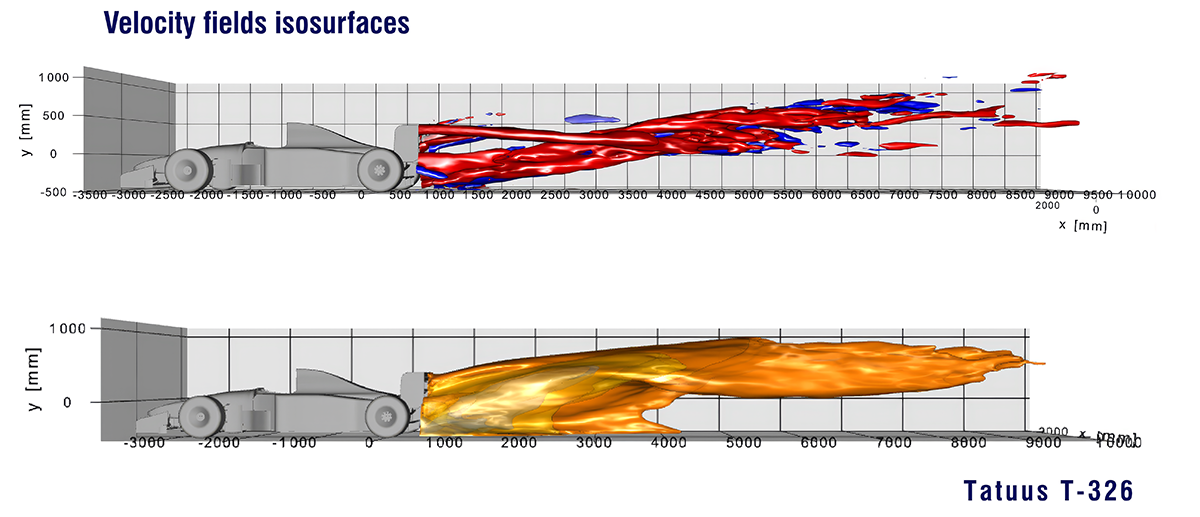
- Detailed wake structure analysis behind full-scale cars for at least 10 car-lengths
- Investigation of drag sources and flow separation
- Downforce and wake interaction studies (e.g., motorsport applications)
- Validation of CFD models under realistic driving conditions
- Platooning vehicle aerodynamics
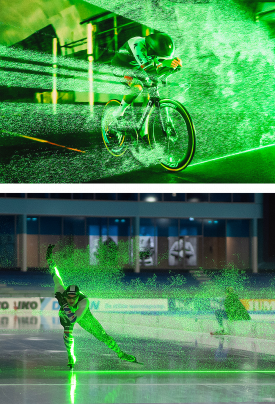
top: Red Bull-BORA-hansgrohe, Red Bull Content Pool / George Marshall
bottom: TU Delft
Sports Aerodynamics
By capturing the airflow and wake structures around moving athletes, the Ring-of-Fire (RoF) system provides actionable aerodynamic data for optimizing posture, equipment, and racing strategies, where even small drag reductions can translate into competitive advantages.
- Sports aerodynamics (football, cycling, etc.)
- Projectile motion and wake dynamics
- High-speed transient flow phenomena
- Interaction effects in groups or platoon testing
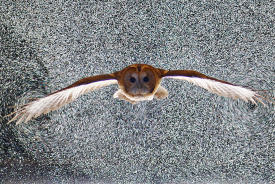
R. Bomphrey, J. Usherwood, Royal Veterinary College London,
Birds from Lloyd and Rose Buck
Biological Flight
In bird-flight studies, the Ring-of-Fire (RoF) system provides a powerful tool for capturing and analyzing complex airflow structures around freely flying animals. For example, in the study conducted by Prof. Bomphrey and Prof. Usherwood from Royal Veterinary College London has revealed previously unknown aerodynamic features in the wakes of freely flying birds, including lift-generating tail vortices and unexpected downwash structures. These findings inspire the next-generation bio-inspired aircraft designs.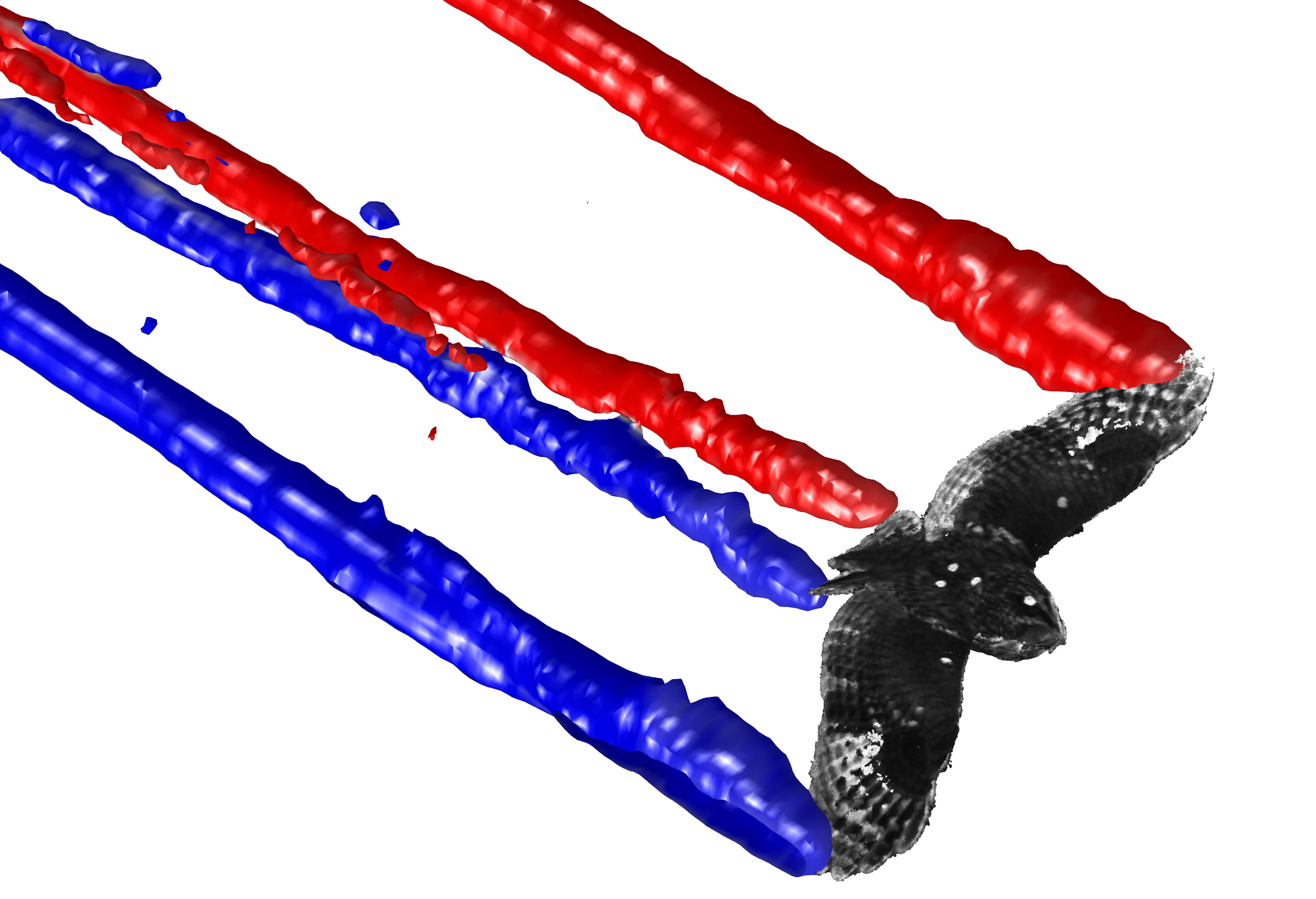
- Wing wake structures
- Lift generation in unsteady flight
- Interaction of vortical structures in natural environments
Real-World Testing Environments
A key enabler of Ring-of-Fire experiments is the availability of long, controlled outdoor test tracks. The Catesby Tunnel facility has emerged in recent years as a perfect setting for on-road aerodynamic testing, offering a unique 2.7 km straight test section, consistent atmospheric conditions throughout the year, and minimal environmental disturbance.
The Ring-of-Fire concept complements traditional wind tunnel testing as part of a broader aerodynamic measurement strategy. While wind tunnels serve as the gold standard for controlled, baseline aerodynamic characterization, Ring-of-Fire testing captures the 3D flow information in real-world conditions. Together, both approaches provide a complete aerodynamic understanding.
As computational models become more sophisticated, the demand for high-quality real-world validation data continues to grow, thereby positioning Ring-of-Fire measurements as a key bridge between simulation and reality in modern aerodynamics research.
References
Automotive Aerodynamics
Hüttig, S., Kühn, M., Gericke, T., Bloem, G., Sciacchitano, A., & Akkermans, R. A. D. (2025). On road vehicle aerodynamics with a large scale stereoscopic PIV setup?: “ the Ring of Fire .” Experiments in Fluids, 66, 125.
https://doi.org/10.1007/s00348-025-04025-w
Erdogdu, A. O., Hollis, D., Charogiannis, A., Nila., A., Boaler, J., & Berg, T. (2025). Historic Vehicle Wake Analysis: ‘Ring-of-fire’ PIV Measurements on the Longest Surviving Jaguar E-Type. 21th International Symposium on Flow Visualization, June 21-25, Tokyo, Japan.
Sports Aerodynamics
Spoelstra, A., de Martino Norante, L., Terra, W., Sciacchitano, A., & Scarano, F. (2019). On-site cycling drag analysis with the Ring of Fire. Experiments in Fluids, 60(6), 1–16. https://doi.org/10.1007/s00348-019-2737-y
Spoelstra, A., Terra, W., & Sciacchitano, A. (2023). On-site aerodynamics investigation of speed skating. Journal of Wind Engineering and Industrial Aerodynamics, 239(May), 105457. https://doi.org/10.1016/j.jweia.2023.105457
Butcher, D., Morris, J., Hollis, D., Charogiannis, A., Nila, A., & Harland, A. (2024). Aerodynamics of an in-flight football using 3D particle tracking velocimetry. Engineering of Sport 15 - Proceedings from the 15th International Conference on the Engineering of Sport (ISEA 2024). https://doi.org/10.17028/rd.lboro.27044827.v1
Biological Flight
Usherwood, J. R., Cheney, J. A., Song, J., Windsor, S. P., Stevenson, J. P. J., Dierksheide, U., Nila, A., & Bomphrey, R. J. (2020). High aerodynamic lift from the tail reduces drag in gliding raptors. Journal of Experimental Biology, 223(3).
https://doi.org/10.1242/jeb.214809