Intensified Cameras
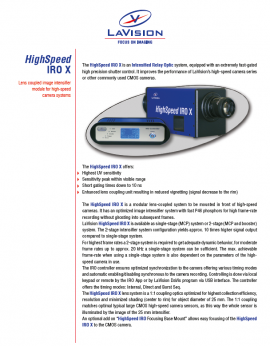
With standard cameras the limitations in the spectral range of detectable signal, lack of signal gain at low light and insufficient minimum exposure time can be overcome when they are connected to an image intensifier. LaVision's "intensified relay optics" (IRO) are modular lens-coupled intensifier units to get an ICCD, ICMOS or IsCMOS from a standard camera without losing the flexibility to continue using the camera also stand-alone.
- UV sensitivity
- Single photon detection
- Nanosecond exposure time for any standard scientific camera (low-speed or high-speed)
Dedicated intensified cameras are available with NanoStar and PI-MAX4 when no separation of a camera from an intensifier attachment is desired or needed. In such case one can take advantage of a compact single-housing unit and fixed lens-coupling or fiber-coupling.
All offered models have options for different wavelength ranges for the 2nd generation or 3rd generation image intensifiers' photocathodes. The product range is complimented by accessories for efficient and safe use as well as full integration in LaVision DaVis software.
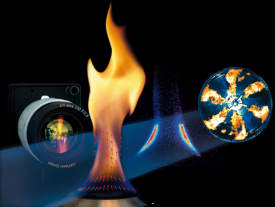
- Combustion diagnostics
- Laser-induced fluorescence
- Time-resolved imaging
- Plasma research
- Bio- and chemiluminescence
- Ballistics
- Hydrogen combustion
- Detonation and deflagration
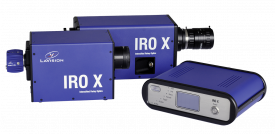
IRO X for standard scientific cameras
The product family consists of models with matching de-magnification for different sensor sizes and an option for a fast-decay P46 phosphor for double-pulse operation. Key properties are the absolute minimum of distortion and vignetting and a low insertion time. A detached controller with touchscreen allows usage without a PC connection and without vibration of an aligned camera head.
- 25 mm intensifier with high resolution
- 1:1 relay lens for larger sensors
- 2:1 relay lens for smaller sensors
- Min. gate time 5 ns in direct mode
- F-mount or c-mount imaging lens connection
- Single shot trigger capability with insertion time
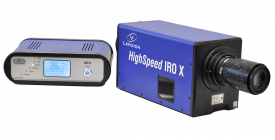
HighSpeed IRO X for kHz cameras
All HS-IROs come with a fast phosphor and 1:1 magnification, either in a single intensifier assembly or a dual intensifier assembly. The two-stage unit enables continuous recording at frequencies of up to >100 kHz without the amplification decreasing due to MCP depletion (the absolute maximum depends only on the camera model). Extremely stable power supplies guarantee sustained, reproducible gain in any situation. Different burst modes can be accessed via the detached controller or PC software.
- Single or dual 25 mm intensifier
- Several burst modes
- Constant sustainable gain at highest framerates
- Min. gate time 5 ns in direct mode
- Synchronizable up to 300 kHz
- Inhibit input for extended lifetime
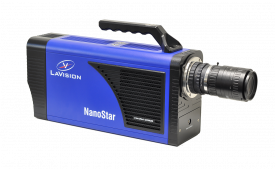
NanoStar with sCMOS sensor
The fixed connection of a 16 bit sCMOS sensor of 4 MPx resolution with a 25 mm intensifier enables a compact housing and minimal cabling. Data transfer via Camera Link HS uses an optical fibre, enabling long distances to a control PC. This makes the camera ideal for use in environments with strong electromagnetic interference. Different photocathodes and a double-pulse option can be configured according to the application.
- 16 bit sCMOS sensor
- 4 MPx resolution
- High efficiency fixed lens coupling
- CamLink HS via fiber
- Double-pulse option
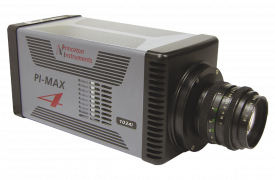
PI-MAX4® with CCD sensor
Shortest gate times can be achieved with this ICCD due to a 18 mm intensifier. It is fiber-optically coupled to a 1 MPx interline CCD sensor and can also be configured as an emICCD (additional amplification in CCD sensor). Data are transmitted via a GigE interface and a wide range of photocathodes and phosphor types are available.
- 18 mm intensifier
- Min. gate time 3 ns
- 1 MPx interline CCD or emCCD
- Fiber-coupling between intensifier and CCD
- Up to 1 MHz synchronizable
- GigE data interface up to 50 m
- Controllable by LaVision DaVis software